

直击考场 | 8月1日雅思考试回忆
01
雅思听力
本次考试整体难度中等偏上,且风格务实,显著弱化了传统技巧型定位,转而侧重考查真实的语义理解与信息分层能力。无论是P4缺乏信号词、P2地图与单选穿插,还是学术类填空题的密集细节,都要求考生具备更强的即时反应与抗干扰能力,对基本功的扎实度提出了较高挑战。
Part 1 博物馆活动
【题型】:填空
(具体题目待回忆)
Part 2 音乐节
【题型】:单选+地图
(具体题目待回忆)
Part 3 生物(动物)学选课
【题型】:填空
点评
这套题难度为中等偏上,并非传统填空套路。其难点在于信息密集且以学术要求为主线,考生需在连续语流中准确抓取课程设置、学制差异及考核形式等具体细节。虽然考查词汇(如tutorials, field work, poster design)均属高频学术范畴,但题干对原文进行了较大幅度的句式重组,要求考生具备较强的同义转述识别能力和信息分层处理能力,而非单纯依赖定位词。整体来看,此题更贴近真实的学术场景信息记录任务,对条理性和专注度要求较高。
|
|
|
|
|
|
|
|
|
|
|
|
Part 4 幸福的追求
【题型】:填空+单选+多选
点评
Questions 31–34
Complete the sentences below. Write ONE WORD ONLY for each answer.
31. A questionnaire survey suggests that old people are the happiest.
32. Some experts believe that the money cannot improve happiness permanently.
33. Happy people are more sociable.
34. Negative thinking also causes unhappiness.
Questions 35–37
Choose the correct answer.
35. Purchasing material happiness is not lasting because:
A. material joys are temporary
B. people tend to compare with modern society
C. wealth cannot get satisfied
36. Theory of hedonic treadmill suggests people with lasting happiness are those who?
A. are good-looking
B. are able to adapt
C. are influenced by income
37. What did Professor Timothy Pychyl investigate in his research?
A. measures of wellbeing
B. control of inner moods
C. control your emotion
Questions 38–40
Choose THREE characteristics that happier people have according to scientist research:
A. regular exercise
B. keep positive mood
C. positive attitude of work
D. send presents for others
E. a healthy lifestyle
F. smile to a bus driver
G. help others
(答案仅供参考,实际答案及顺序可能有变化)
02
雅思阅读
在8月的第一天,迎来了大陆雅思纸笔考试的最后一个月的第一场考试,本场考试之后,大陆考生仅余下8.8/8.15/8.22/8.29 四场纸笔考试的机会。今天的考试中p2 list of headings 题型以一组7道题的数量华丽回归,p3的鲸鱼文化虽然是看着熟悉的动物话题,但是文章中的专业生词一堆,加上题型本身的定位难度,继续加码本场考试难度。
Passage 1 A brief history of canned food 罐装保存发展史
【难度】:一颗星
【题型】:判断7+填空6
【类别】:历史
(答案仅供参考,实际答案及顺序可能有变化)
点评
Passage 2 The longest conservation fence in the world
【难度】: 三颗星
【题型】:List of headings 7+填空4+选择2
【类别】:社会
【考频】:2019.09.14
(答案仅供参考,实际答案及顺序可能有变化)
点评
Passage 3 鲸鱼文化 Whale culture
【难度】:三颗星
【题型】:判断题5+填空3+多选3+段落信息匹配3
【类别】:生物
【考频】:机考高频
参考原文
Whale Culture
A Most social scientists stubbornly resist the idea that animals have culture. Even such advanced cetacean mammals as whales and dolphins clearly don’t have art, literature, or architecture. But patient observation over many years has begun to reveal behaviours that can only be learnt from other whales. And that, say whale biologists, constitutes culture.
B So far, humpback and killer whales provide the best evidence of culture in cetaceans, and the song of the male humpback is among the most striking examples. Humpback populations in different oceans sing different songs, but within the same ocean they all stick to the same one. However, during the breeding season the sounds change, as it appears that females are drawn to novel songs. One male might add an extra set of groans; another might drop a series of grunts. Soon all the other males have altered their own rendition to incorporate the changes until they are once again singing the same song. Since this occurs among thousands of whales spread across a vast part of the planet, the change cannot be in response to any factor in the animal’s environment. The latest version of the song can be learnt only from other whales–almost certainly by imitation.
C Culture plays an even bigger part in the life of killer whales. Nowhere is this more obvious than along the north-west coast of America, where killer whales are split into two distinct populations– ‘residents’and ‘transients’. They live in the same stretch of water, but they don’t mingle. In effect, they belong to two quite separate cultures. Residents live in stable groups, or‘pods’, made up of two or three mothers and their offspring–perhaps 20 whales in all. Calves stay with their mothers throughout adulthood, and in many years of observation no one has ever seen a whale switch pods. Transients travel in smaller, more changeable groups of between three and six.
D One of the most obvious distinctions between the transient and resident societies is the way they impart information. Killer whales detect prey with a range of echo-locating clicks, but converse with a vocabulary of squeaks, whistles and whines. Transients have only a few such calls, and all transient societies share the same ones. Residents have a much more extensive repertoire, and each family group has its own unique and distinctive set of calls. Despite regular interaction between them, each resident pod sticks firmly to its own dialect. Research shows these dialects are maintained for at least 40 years.
E To qualify as part of killer whale culture, dialects must be learnt from other members of the pod. Animals with different dialects share the same waters, so the variation can’t be a product of physical environment.‘And we can throw out the notion that dialects are inherited,’says Lance Barrett-Lennard of the University of British Columbia. He has spent the past seven years analysing DNA from 270 whales. His paternity tests reveal that female killer whales invariably attract mates from outside their own pod–males with a very different dialect. If dialects were programmed by genetics, call patterns from both father and mother would be passed on to the calf.‘A calf uses the calls of its maternal pod very precisely. There’s no input from the father,’says Barrett-Lennard.
F The question still remains–is this culture? It is, according to Frans de Waal of Emory University in Atlanta, who argues that culture is just another biological adaptation that has evolved in many creatures. One benefit of viewing culture in this way is that you can start to understand how and why it might have arisen in these creatures. Whales have several biological attributes that give them an advantage in social learning. Apart from their advanced mental abilities, they are adept at recognising sounds: ideal for communicating in the marine environment. Many species spend years rearing their offspring, and live in small, stable, multi-generational societies, a social system that provides ample opportunity for teaching and learning.
G But why have cetaceans evolved the ability to learn from other group members?Experts in whale biology believe that ecological factors and the need to adapt to sudden changes in the environment played a large part in the emergence of culture. Although the ocean is a relatively stable habitat in many ways, it is highly changeable in one crucial respect–the availability of food. One moment there might be a plentiful supply of fish, the next they’ve disappeared. When that happens, the past experience of senior members of the group–and the ability to share this knowledge –is a huge asset. The dialects of killer whales allow members of the group to identify each other,enabling them to share information about food hot spots. Among resident killer whales, it also allows females to avoid inbreeding by picking out a mate with a strange dialect from outside their pod, says Barrett-Lennard.
H The importance of sharing information seems to have led to biological changes in at least some species of whale. Female killer whales, like humans, are very unusual in that they live up to a quarter of a century after they have had their descendants. And what whale matriarchs offer is the most important thing of all–cultural knowledge, vital for the group’s survival, passed directly from one generation to the next.
Questions 27–31
Do the following statements agree with the views of the writer in Reading Passage 3?
In boxes 27–31 on your answer sheet, write
YES if the statement agrees with the claims of the writer
NO if the statement contradicts the claims of the writer
NOT GIVEN if it is impossible to say what the writer thinks about this
27 Resident killer whales appear to remain with their maternal group for life.
28 Resident killer whales have a more restricted range of calls than transients.
29 There is a vocabulary of sounds which is common to all transient killer whales.
30 Resident killer whales share the dialects of other resident communities living in the same waters.
31 The dialects of transient killer whales remain constant over time.
Questions 32–34
Complete the summary below.
Choose NO MORE THAN TWO WORDS from the passage for each answer.
Write your answers in boxes 32–34 on your answer sheet.
It has been observed that resident killer whales invariably live in fixed family groups, known as 32 __________. Each of these has its own unique set of calls, despite close contact with other family groups. As the same areas of ocean contain many different groups with widely varying dialects, it is clear that these differences could not have emerged as a result of the whales’33 __________.
According to tests conducted by Lance Barrett-Lennard, a calf communicates exclusively with the dialect of the group to which its 34 __________ belongs. Barrett-Lennard also rejects the idea that the call patterns are inherited.
Questions 35–37
Choose THREE letters, A–F.
Write the correct letters in boxes 35–37 on your answer sheet.
Which THREE of the following features of whales are mentioned in the passage?
A intelligence
B physical strength
C sensitivity to sound
D prolonged life span
E lengthy period of fertility
F adaptability to a variety of foods
Questions 38–40
Reading Passage 3 has eight paragraphs, A–H.
Which paragraph contains the following information?
Write the correct letter, A–H, in boxes 38–40 on your answer sheet.
38 an example of the kind of information passed by whales to each other
39 a reference to variations in communication styles between different cultures within one species
40 ways in which the skills of whales are favourable for the development of culture
(答案仅供参考,实际答案及顺序可能有变化)
点评
03
雅思写作
小作文
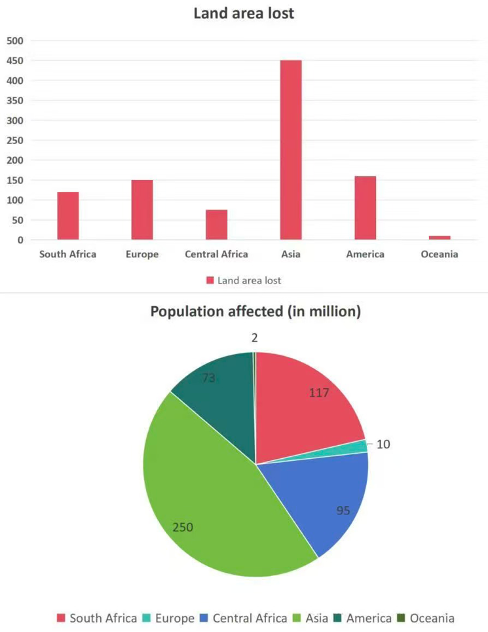
点评
今天考察的小作文是组合图。两幅图的主题分别是不同区域由海平面升高所导致的土地流失以及受海平面升高影响的人的占比。
针对组合图,大家的写作思路可以按照一幅图一段,在宏观概括的部分说出两幅图之间的联系。根据图片我们可以发现,两者之间存在比较强的关系。受海平面影响导致土地流失的严重程度和该地区受到海平面增长负面影响的人数呈现正相关的数据关系。
大作文
点评
今天考察的是一个比较的考点,这类问题的难点在于,不能各聊各的好处,而是要对比两者的好处,从而顺利回应题目的考点。大家在写中心句的时候,就需要体现出比较这层意思,从而增强任务完成度。
建议的结构可以采用双边。主体段第一段写:好的数学技能可以帮助理财,这个好处是沟通技能无法完成的。人们可以利用数学技能去预算规划,投资理财,评估风险,帮助财富增加,而这些好处无法通过后者完成。主体段第二段可以写:好的数学技不能帮人很好的融入社会,而这是可以通过好的社交技能实现的。人是社会性动物,沟通技能可以帮助人扩大社交圈以及在碰到冲突的时候妥善解决。最后一段可以表明自己的看法。我觉得数学和社交技能对于生活所带来的好处是在不同方面的,所以无法明确说谁比谁更重要
相关文章



热门项目
免费预约试听
- 雅思
- 托福
- A-Level
- 留学
- 考研
- KET/PET
- OSSD
- DSE
- TOEFL Junior
- 多领国
- 小语种
- 锦秋国际
- AP
- GRE/GMAT
- SAT/ACT
- PTE
- 腾飞计划
- 其他
备考工具
热门活动
热门文章